Historical April–May 2022 article. Dates, prices, services and contacts describe the source period; current availability has not been established.
So much of our collective consciousness these days is centered on “big issues” such as the state of democracy in America and the war in Ukraine. Across political parties, race, class, and ideology we are all engaged viscerally in what will happen in the Ukraine and to the United States.
In spite of years of troubling polarization here, the crisis in Ukraine has given us memorable examples of unity like our bipartisan support for sanctions in Russia and robust support for military and financial aid to President Zelensky and the people of Ukraine.
While this unity may dissipate as we get closer to elections, at the moment, it is a welcomed breath of fresh air.
It was through the lens of these “big issues” that I began to think about our new Ward 10 which arguably will be one of the most diverse wards in the City of St. Louis.
I thought Democracy and its manifestations are also local. Democratic values are reflected by how we engage others in our community who may not live on our block or in our neighborhood. Broadly speaking, every major demographic category is represented in Ward 10.
From the highly educated and wealthy to citizens who are underemployed or not employed at all.
There are differences in the number of elderly and those under the age of 18, and there’s a growing community of refugees and immigrants.
Most important will be how dedicated we are in Ward 10 to use community strategies that reflect the ideals of democracy: to engage the diverse voices and bring benefits to all of our citizens regardless of race or ethnicity, income, age, education, or residency in particular neighborhoods.
We often make huge and erroneous assumptions about people and places, a reality that often stymies progress and community innovation. Demographics do not allow us to find the “ unique exceptions” nor do they help us mine for unique opportunities that are not apparent.
The vehicle to finding the gems and opportunities is community engagement with the people themselves encouraging the sharing of their perspectives and insuring their representation.
In 2010 a young Ethiopian teenager was killed in the Hodiamont area near Page Blvd. and Skinker. At the request of one of the families living there, I went to the apartment complex where the incident occurred to learn the details and to see how Gitana Productions, an arts and education program, could assist in the midst of a tragedy.
After talking with families, the owners of the property, city officials and
the police, it was clear that promoting dialogue between very diverse neighbors was critical.
As a result, with input from the community, the Amherst Park Peace Festival began, bringing a diversity of community members together through music, inclusion of community resources, and education. Community people helped select the artists, the food, and many residents volunteered. African Americans, Latinos and other immigrant began talking to each other and working on a joint project for the first time.
Here is what I learned: Community engagement is a critical tool for democracy.
It is a strategy that encourages participation, and allows us to hear different perspectives.
It is a strategy of inclusion and builds community.
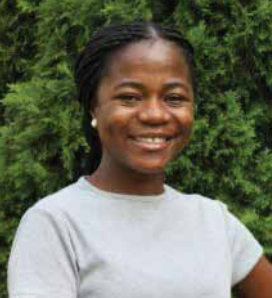
The Amherst Park Peace Festival expanded from 2-3 collaborating organizations to 15. Spanish and African American artists joined the festival from all over the region as did institutions and local organizations. Families wanted their kids to have constructive activities after school so we started the Global Education program, a cross-cultural arts and education program located in one of the apartments in the area that ran for 10 years. Sunita Manu, a refugee from Liberia lived on Hodiamont, was a teenager in that program for many years receiving academic coaching and counseling.
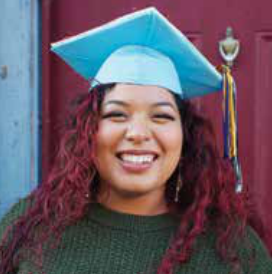
The good news! Sunita just graduated from St. Louis University with a Ph.D. in Public Health Policy. Maria Anaya, an immigrant from Mexico also participated for a number of years and she is now a sophomore at Webster University on scholarship. Without deep community engagement we would not have found Sunita and Maria nor would we have known what connections were critical to their individual success. Looking at the crime rate and demographics in the area many would not have imagined that such extraordinary individual outcomes were possible.
It took community engagement and radical listening to hear and see what was needed and what would work. Maria and Sunita and many others give testimony to the fact that demographics are not predictors of success.
When I think about Ward 10 it is my greatest hope that we will be engaged enough to find such people to help us with community building.
Original photograph caption
Sunita Manu.
Originally published in The Times of Skinker-DeBaliviere, April–May 2022.
Read this article in the original newspaper issue.
Original source: SD_Times2022_04.pdf, printed page(s) 1, 3; PDF page(s) 1, 3.





