Original printed byline: Cecelia Nadal
Historical April–May 2021 article. Dates, prices, services and contacts describe the source period; current availability has not been established.
“To find common ground you must be willing to search for it.” – Carmine Savastano Last month’s article, “The Siege and the Hope of a Beloved Community” was shared as a vehicle for catharsis as we all grappled with the shocking reality of the January 6 insurrection at our Capital.
As I reported in that article, my own purging started while watching every gruesome detail of the invasion on television.
On that day my consciousness rotated between the unfolding events on screen and memories of our history of race in America. Slavery, Charlottesville, the protests in Ferguson and the murder of George Floyd collectively punched me in the gut.
It was the memory of the nonviolent Civil Rights martyrs that helped me step away from the pain of that drama on January 6. People like Reverend George Lee that used his printing press and pulpit to get the community to vote and was murdered when he refused to stop.
There was Viola Gregg Liuzzo , a mother from Detroit who felt compelled to help with the Selma march and was killed by Klansmen in a drive by shooting.
These were activists who fought for the democratic rights of their fellow citizens.
They were guided by high moral principles and love for their community.
When Dr. Martin Luther King developed his vision of the “beloved community” he understood that to remove hatred, injustice and poverty this would require an engagement of our systems such as education, law, healthcare and criminal justice reform. Such initiatives however would be made through the lens of the “beloved community” where the “other” was not seen as an enemy but would be seen as a potential ally.
I had to ask, “how do we begin to move towards the beloved community having suffered 4 years of battle fatigue from extreme political polarization and credible threats to our democracy?
The January 6 insurrection and my reaction compelled me to acknowledge that the “Trump era” left many of us with symptoms similar to trauma.
I needed to replenish my energy, think about responding rather than reacting to the polarization and take a deep breath.
I had felt more anger during Trump’s presidency than in my entire 70 year lifetime.
There were tons of friends and neighbors around me who felt the same way.
When we shared our anger about the lies and insults from the White House and GOP, the chatter from my friends sounded like a school of piranha devouring an object a hundred times bigger than the entire shoal of fish! Yes, it got scarry…even on zoom!!!
We did; however, all feel better afterwards!
My higher self knew that if we are to heal this country it is vital that we begin to find common ground as a pathway to communication, honesty, trust and the beloved community. Ironically, just before the pandemic was announced I was involved with a culminating event that highlighted one of the most extraordinary experiences I have had.
My goal was to bring Germans and African Americans together in rural Missouri, it took almost 3 years to do so.
I will tell you that story as a way of showing how powerful finding common ground can be and how you must prepare and stay present with your own bias.
In 2018, I conducted research for a play I was writing, An Amazing Story: German Abolitionists of Missouri.
As an African American playwright, I felt compelled to learn everything that I could about German culture and history in Missouri before and during the Civil War.
I decided to take a trip to Hermann, Missouri -a quaint outstate Missouri town where the Deutschheim State Historical Site was located.
The site provided a glimpse of German immigrant life in the mid-1800’s with its well- preserved structures including a typical middle-class home with furnishings, a winery and a newspaper press room.
I took the longer scenic route on Highway 100.
I went alone and saw mostly flat land and a car or two every 15 minutes. At a certain point on that isolated road I thought, “What the hell am I doing out
here alone? What if my car stops? What if the Klan is located in these parts?” Despite my fear and hesitation, I finally managed to get to the Deutschheim, took the tour and was inspired by what I heard and observed in Hermann. Margaret, the tour guide was phenomenal and very supportive.
When I left Hermann my commitment to the play was strengthened by what I learned of its history, culture and people.
I doubted however whether Gitana Productions, the nonprofit arts organization I founded, could have the level of community engagement in Hermann that typically accompanied our plays in the St. Louis region. Was I having those feelings because of the preconceived thoughts I had about outstate Missouri? Would German Americans and African American want to have conversations on race?
I decided that the response to the play should determine how much, if any, community engagement Gitana would do. Finding common ground cannot be imposed it has to be something that the parties agree to!
In my heart I was not confident they would want to talk about race relations.
To my surprise, the response to the play in Hermann was overwhelmingly positive.
With a full house at the Showboat Community Theater there was much interest in the story! By this time, I had a few great allies in Hermann and asked them if they thought people might come to a meeting to discuss this history and the status of relationships between Germans and African Americans today.
I usually conducted such conversations and asked if they thought I should have someone else facilitate. Their answer, “We know you now!” So much for my fear of outstate Missouri and the Klan!
The experience was a healthy one and I had learned something about the towns people of Hermann.
They were hospitable, independent and very interested in their history.
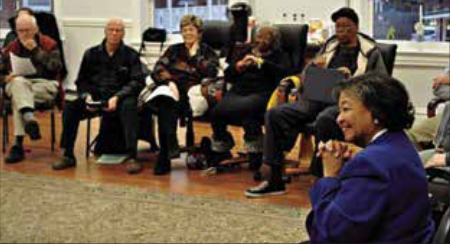
In December 2019 we invited Blacks and Whites (mostly German Americans) to a conversation on race in the Hermann area with great success! Painful stories were told as well as stories where dignity and warm fellow-feeling were exchanged between Germans and African Americans in the area. Six months later I learned that Gasconade County where Hermann is located is 85% Republican!
I was forced to confront my bias at several points during my 3-year relationship with Hermann. Had I not done so, the quest for finding common ground would not have occurred.
I also realized that my Hermann allies had to do the same and I appreciated them for that. Through this experience my personal bias about the people living in rural outstate Missouri needed to be checked at the door and I would never again underestimate the importance of building relationships one person at a time before embarking on the group process.
I was very fortunate to have developed relationships with individuals from Hermann that helped me to understand the town and its culture before moving forward with difficult conversations on race.
The success of the play and the culturally relevant research I conducted in developing the German American characters was an important introduction of who I was to the people of Hermann.
I would learn how much they appreciated my commitment to authentic presentation in telling their story. What if I ‘d known that 85% of the people, I met in Hermann were Republican before going to Hermann? Would I have gone to Hermann at all after the siege in Washington DC ? Like so many, I did everything in my power to elect President Biden and Kamala Harris.
If I had to do it again, I would fight just as hard as I did, HOWEVER, I would not allow “the fight” to override the importance and role of the “beloved community.” The Hermann experience, the January 6 siege, have reminded me, that as an American citizen, “the fight to win an election” on its own is far less important than the principles that underlie that fight.
There are 72 million people who supported the prior President but they supported him for very diverse reasons.
It is crucial that we find our common ground with those that we can within that 72 million people if we are to make things better in this country. “Finding Common Ground” is an essential strategy for healing our country and it takes skill, noble intention and the willingness to look at our own bias.
It takes the willingness to genuinely talk to each other and to genuinely listen to each other. Finding Common Ground will take time, patience and a strong desire to make this country live up to its own ideals. Are you willing to take the first step? (Visit YouTube “Black People and White People Find Shared History in Outstate Missouri” and see recent article by Cecilia Nadal in the Hermann Advertiser Courier, “Embracing Each Other’s Culture: Key to Beloved Community”)
Original photograph caption
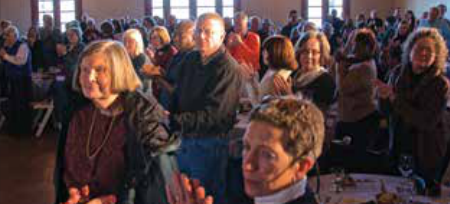
Audience photograph accompanying the Hermann common ground essay; individuals not captioned.
Originally published in The Times of Skinker-DeBaliviere, April–May 2021.
Read this article in the original newspaper issue.
Original source: SD_Times2021_04.pdf, printed page(s) 3, 4; PDF page(s) 3, 4.





