Historical Summer 2024 article. Dates, prices, services and contacts describe the source period; current availability has not been established.
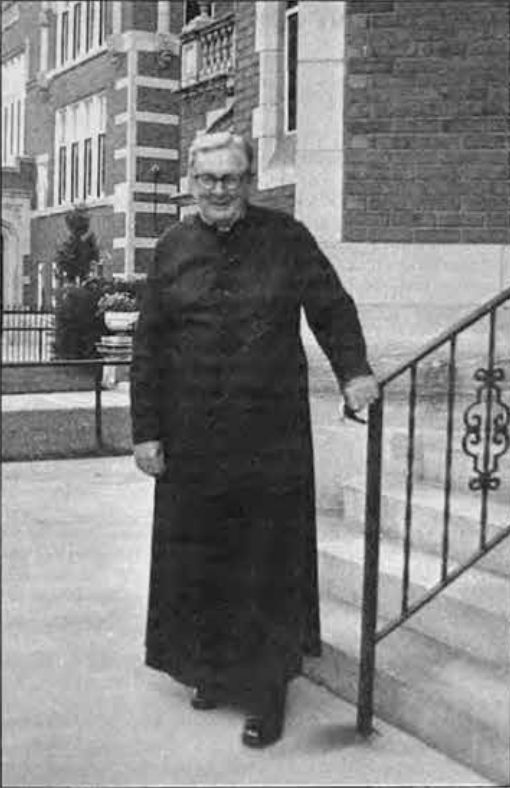
During the turbulent times of the 60’s and 70’s, Skinker-DeBaliviere benefited from the presence of St. Roch and its cleric, Father (later Monsignor) Robert Peet.
The Roman Catholic Church divides metropolitan areas into parishes, and, generally, Catholics attend their parish church. Research in the Boston area (Gerald Gamm, Urban Exodus) has demonstrated that white Catholics are not as likely to flee an area when racial change occurs because of their parish ties. St. Roch Parish is a prime example. Father Peet took part in the march in Selma, Alabama, during the civil rights movement and felt a deep commitment to equality.
As Jean Eberle pointed out in 1981: Father Peet has been an unobtrusive but dominant force in the revitalization of the Skinker-DeBaliviere area.
When he arrived in May of 1962, the “smart money” people at real estate companies, lending institutions and insurance firms were writing off this neighborhood. At the same time the changes arising from Vatican II were going into effect in the Catholic Church, so many felt double uncertainty and frustration. One of Father Peet’s first announcements was that St. Roch’s would build a new school building which would include the long-needed gymnasium.
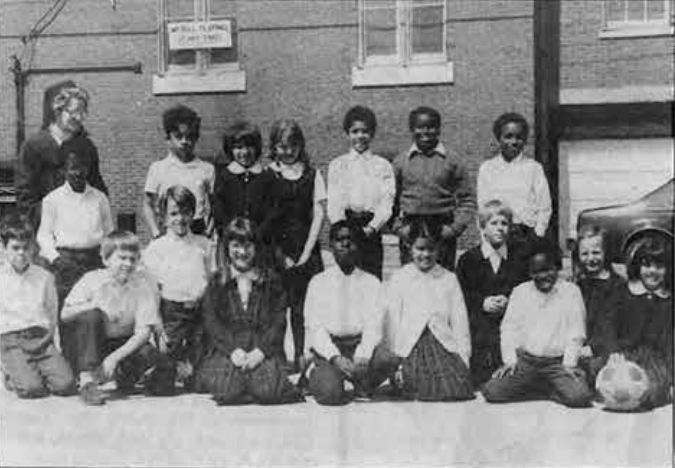
This enabled the sixty St. Roch’s children attending other schools to return to St. Roch’s in 1964, and made space available for other local students. Then, in 1970, St. Roch’s made a bold announcement, that it would open its school to non-Catholics. Many, many parishioners worked hard with the larger community to make this experiment a success.
Dr. Jose M. Sanchez, Jr., president of the school board, announced that “St. Roch’s intends to become a genuine neighborhood school, while continuing to maintain its traditional high academic standards.” Writer Jim Hitchcock pointed out in his 1970 article that: St. Roch’s has consistently had the best record of any parochial school in the city…and ranked first in the Iowa Basic Tests…The school also boasts some distinguished alumni, including the late Dr. Tom Dooley, the famed Laos surgeon, and Michael Harrington, author of The Other America, a book credited with focusing national attention on the problem of poverty in the 60’s.
The school and the church were opened to the wider community. Many SDCC meetings were held at the church hall and “Scariot Hall” was the site of numerous parties, where Catholics and “social Catholics”, white and black, would gather.
These events heightened the sense of community for all involved. People still reminisce about St. Patrick’s Day gatherings. Kathleen Hamilton would play the piano and Father Peet would croon.
The laughter and warmth of those occasions can easily be brought to mind by those who were there.
It is fortunate for Skinker DeBaliviere that Father Peet, Sister Leo Ann, and so many parishioners believed in the neighborhood. One resident remembered that Father Peet used to walk around the neighborhood in the evening so that residents would see him and feel less afraid.
He helped many through darker, more troubled times here.
His continual human touch, his steady involvement with the Council and other neighborhood organizations, his approachability, and his linkage of St. Roch to the community played an immeasurable part in the neighborhood’s comeback. Sister Leo Ann Bub, principal of St. Roch’s School for many years, was also a fearless fighter for the children and neighborhood.
She worked closely with non-Catholic parents and lay teachers, as well as the other Sisters of St. Joseph, Sister Charles, Sister Dorothy, Sister Herbert, and others who taught at the school during this challenging time.
In 1981 Msgr. Sal Polizzi was named by the Archbishop as pastor of St. Roch’s. Msgr. Polizzi built on that strong foundation and ensured the viability and fiscal health of the school and the church for a long time to come. More about these later times will be explored in future installments.
Original photograph caption
Monsignor Robert Peet, original June August two thousand facsimile photograph.
Originally published in The Times of Skinker-DeBaliviere, Summer 2024.
Read this article in the original newspaper issue.
Original source: SD_Times2024_06.pdf, printed page(s) 6; PDF page(s) 6.





