Historical February–March 2020 article. Dates, prices, services and contacts describe the source period; current availability has not been established.
It is hard to believe that we are well into the presidential race of 2020 with the general election being months away, but with our election cycles getting longer and longer, the primary season has been underway for months. Who will be the president is clearly critical in our governance, but state and local candidates have an immediate impact on the successes and failures of our region. Choosing the candidates that you most align with in an atmosphere of disinformation is a daunting task.
To prepare for the upcoming elections, be aware of the dates in which you must be registered, note the actual election dates, confirm your registration, confirm your polling place, and research the candidates and initiatives.
The important dates for the 2020 election cycle are: Feb 12 – Last day to register to vote for the primary Feb 26 – Last day to request an absentee ballot for the primary Mar 9 – Last day to do in person voting for the primary Mar 10 – Presidential Primary Aug 4 – Primary for non-presidential candidates Nov 3 – General Election To check your current voter registration, go to sos.mo.gov/elections/goVote Missouri/register, enter your first and last name, your address, birthday, and county.
If you are currently registered, your ward and precinct will be displayed. You can click on the link to see what initiatives are on the ballot and the address of your current polling place. (There is currently discussion underway to move some of our polling places, so be sure to check before election day).
If you have problems with your registration, you can contact the St. Louis City Board of Elections (for St. Louis City Residents) at 300 N. Tucker, St. Louis, MO 63101 or call them at (314) 622-4336.
If you are not currently registered to vote, you can submit an online voter registration at that site.
Now comes the hard part, researching the candidates and initiatives. Information is shared differently today with the majority of consumers now getting their news digitally via online articles and social media.
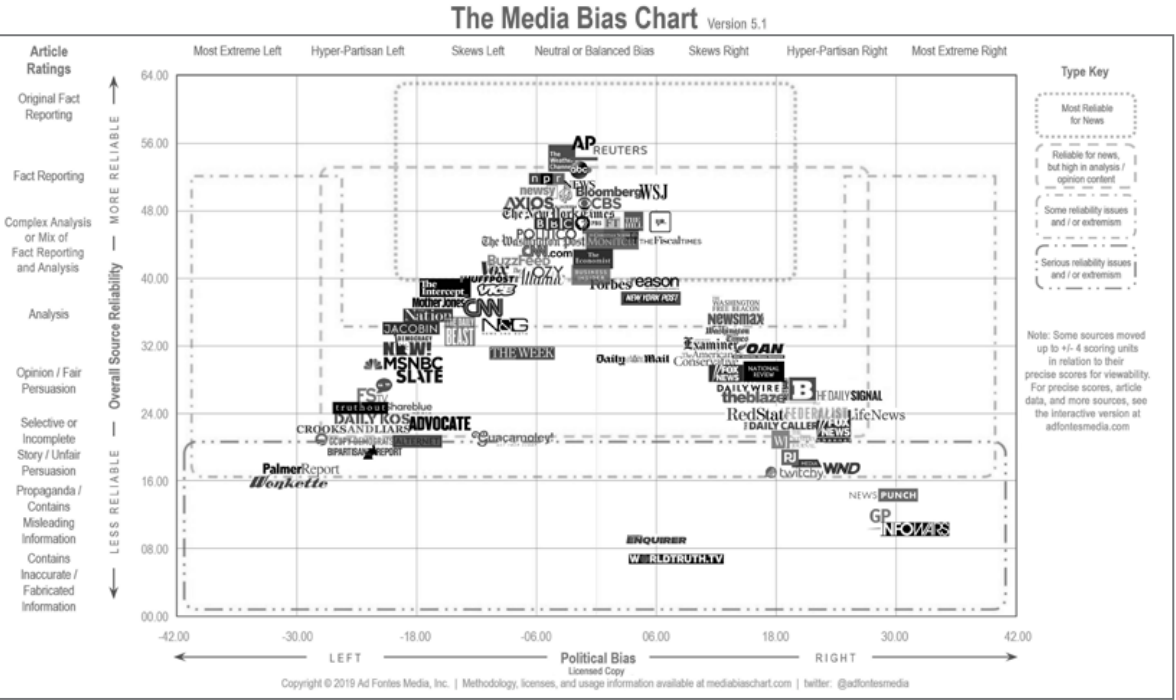
It is not easy to spot a fake news story but here are a few tips. Be aware of “confirmation bias,” where consumers are fed stories through their social media profile that validate their existing beliefs without a balanced approach. Look for triggering language in your news consumption – does one site say ‘the scandal’ when another site says ‘the hoax’ but a fair and unbiased site would discuss ‘the issue’. Verify the author and the date that an article was actually written. Many articles get passed around again years after an issue has been corroborated or debunked. Ad Fontes Media is an organization that researches factual reporting on the web to determine media bias, and has produced a chart that has been used as a resource by educators to give a visual map of the news landscape.
To check the validity of statements yourself, you can research in several different places on fact checking sites: Mediabiasfactcheck.com – is an independent online media outlet Factcheck.org – a non-partisan non-profit part of the Annenberg Public Policy Center of the University of Pennsylvania Politifact.com – Pulitzer Prize winning site owned by the not for profit Poynter Institute for Media Studies Snopes.com – site with a search engine to dispel circulated rumors Washingtonpost.com/news/factchecker – part of traditional media (if you are skeptical of traditional media) but nothing is reported without three sources.
There are several good rules to follow when fact checking. Always read past the headline.
The actual article may have nothing to back up the ‘click bait’ grabber. Leave the site you are reading in order to validate information that they are providing (In other words, don’t just trust their ‘About’ page). Search the organization with quote marks around their name to get results on who funds that organization and on their credibility. Search to see if other reputable news outlets are reporting the same story. Ask for evidence that backs up the claim. And importantly, if you haven’t validated a story, do not share it.
Now that we know how to read about the candidates and initiatives, there are a couple of ways to narrow down which candidates and issues are most aligned with your value system. For national candidates there are a couple of websites that you can use to narrow to a candidate that campaigns on the issues that are most important to you (what they do when they are elected is not guaranteed). Isidewith.com and washingtonpost.com both have quizzes where you can answer questions on many positions, and the quiz will match you to a candidate running on those issues. You can also go to independent websites such as the League of Women Voters to get a comprehensive listing of each candidate, their previous experience, and their platform.
On current initiatives on the ballot, regional and local newspapers often have an outline of the issues so that you can interpret the complicated and often times tricky language that is on the ballot. You can ask a person that you respect and admire that would have particular knowledge about an issue what their opinion is. For example, if there is a school board election, ask a friend who is a teacher or administrator who they might support.
This all amounts to some work, but choosing who runs our country, state, and city determines what priorities are focused on, what resources are available to our citizens, and what rights we will have going forward. Put in the work.
This is a chart created by Ad Fontes Media that has been widely used to demonstrate media bias in today’s information landscape. Keep in mind that media bias is very complicated and nuanced.
This chart should only be used as a visual representation based on the methodology of Ad Fontes Media. You can visit www.adfontesmedia.com for an interactive chart and more information on their methodology.
Original photograph caption
Media Bias Chart version five point one, original historical illustration.
Originally published in The Times of Skinker-DeBaliviere, February–March 2020.
Read this article in the original newspaper issue.
Original source: SD_Times2020_02.pdf, printed page(s) 1; PDF page(s) 1.





