Historical February–March 2001 article. Dates, prices, services and contacts describe the source period; current availability has not been established.
Where?
If you live in or own a building located between DeBaliviere on the east, the City Limits in Parkview on the west, Lindell on the south, and Delmar on the north, you are part of The Skinker-DeBaliviere/Catlin Tract/Parkview Historic District. (Kingsbury Square and Bi-State are not included.) A map with the exact boundaries is available at the Skinker/DeBaliviere Community Council office at 6008 Kingsbury, telephone 862-5122.
The area was made a historic district in 1978. Why?
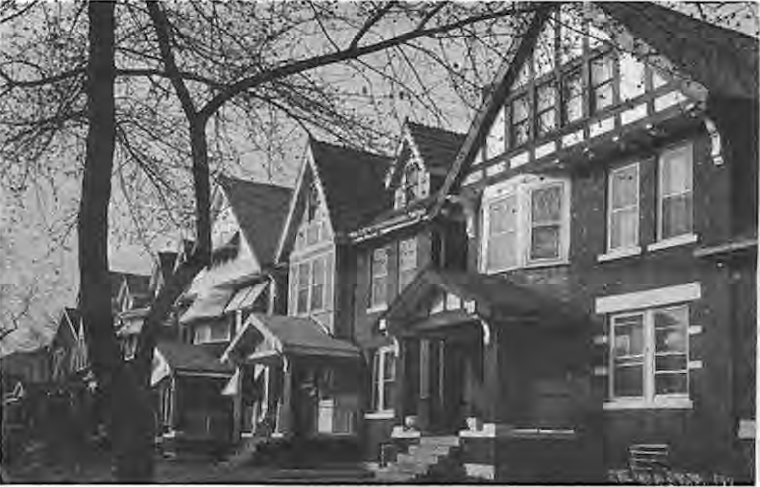
This area of western St. Louis City is considered to be architecturally significant because it is a well-preserved, early twentieth century neighborhood possessing a high degree of visual continuity – a quality referred to as a “sense of time and place.” A look down any one of our streets illustrates this; the rhythm of roof and porch lines, window patterns, and building materials (almost always brick with some stone accents or facades).
The various streetscapes of the neighborhood represent these concepts in different scales: Lindell (Catlin Tract) the grandest followed by the streets In Parkview and the 6100 block of Kingsbury; however, the three blocks of DeGiverville possibly exemplify the sense of time and place which makes this neighborhood such a great example of early twentieth century, residential architecture. What does this mean? For their own as well as for neighbors safety, all building owners have a responsibility to maintain their structures.
When it is within a historic district, there is the added duty to respect the architectural nature of the building.
There is a certain pride knowing that one is in charge of a piece of history.
In our case, it is a piece almost a century old. Owners along the way have taken this responsibility to heart which is why we still have such an intact neighborhood.
In an accompanying article, readers learn that the Skinker-DeBaliviere area will be inspected for Code Enforcement possibly as early as this spring.
With those inspections may come code violations which owners will need to be corrected.
The purpose of this article is to outline what work requires permits, what the historic district standards are which apply to permit work, and what the process is to get a permit. Permits A permit is an agreement between the City and an applicant where the applicant agrees to follow the City Codes and the City agrees to inspect the work to ensure that Codes are followed.
It is the responsibility of the owner get the necessary Permits. Contractors may apply and receive the permit (and in the cases of plumbing, electrical, and mechanical work almost always do).
However, if a contractor tells a property owner that permits are not necessary and proceeds with work only to have the City issue a stop work order, the owner will be the one responsible. Owners may question why a permit is necessary.
The simple answer is “for your own protection.” As an owner, you are assured that your plans meet City code and Historic District Standards.
A Permit requires the City to inspect the work.
The inspector is there to protect the property owner from shoddy work, faulty materials, deviations from approved plans, and violations of the Code which may result in unsafe or hazardous conditions. Quality work improves property. values.
In the Skinker-DeBaliviere Historic District there are two types of Permits: a Building Permit and a “CRO-only” (Cultural Resources Office) permit.
A Building Permit is required when any demolition, structural change or major alteration is made to a building or when any new construction is done.
A “CRO-only” permit is for exterior work which normally does not require a Building Permit.
A partial list follows of what these permits cover: exterior masonry painting, new gutters and downspouts, replacement windows and doors, repair and replacement of decorative trim, and awning and canopies.
In many cases, Building Permits will usually include review by the Cultural Resources Office as well as the Building Division because the scope of work includes architectural details and materials. Permit review by the Cultural Resources Office is necessary to make certain that maintenance, repairs, construction, and demolitions comply with District design standards.
These standards were written to protect the integrity of the early-twentieth century buildings which make Skinker-DeBaliviere architecturally noteworthy.
In the fourteen City Districts, the enforcement of standards has proven to stabilize, and in some neighborhoods – including ours, enhance property values.
To get a Permit, apply in Room 425, City Hall. Bring two photographs (front and back) of the building or site, showing clearly the location of the project.
The application must also include a description of the work to be performed or architectural drawings for the proposed work.
If the work includes work that would affect the site—fence, garage, porch, a site plan (drawn to scale or clearly dimensioned) also must be submitted.
The fees for applications are: “CRO-only” permits are $9.00 for any work from $1 to $2,500 and $24 for jobs exceeding $2,500. Building Permits cost an additional $6.50 per $1,000 of construction expense.
If plans are clear and meet historic district standards, many permits can be approved over-the-counter at the “Hotspot” desk in the Building Division.
There is a staff member from the Cultural Resources Office from 8 a.m. to 4:30 p.m. Other applications may require more time for review because additional information is needed or revisions to comply with standards are required. Applications for any demolition, or window and door replacements are routed to the Cultural Resources Office and will not receive over-the-counter approval.
Most permits are approved within five working days. What Happens If Work is Done Without the Necessary Permits?
When a complaint is made, a Stop Work Order is issued by either the Building Division or the Cultural Resource Office. Work cannot resume until a permit is obtained by following the above steps. Failure to obtain the necessary permits may result in prosecution in the Housing Court with a maximum possible fine of $500 plus court costs. (The permit fees are much less.) What are Skinker-DeBaliviere’s Historic District Standards?
In our neighborhood, standards apply to work visible from the street. Generally, that means only the front of the building; however, if it is located on a corner or with elevations exposed because of vacant lots on any side, rear and side views will also need to meet standards. At this time, the Historic District Review Committee is working on a clear, but detailed, hand-out which will describe the District’s standards, suggested materials, and procedures.
This should be available by early April.
In addition, the Cultural Resources Office should have available a booklet describing window replacement, a subject which is causing controversy in most of the City’s Districts. Our ordinance, which includes standards, is available on the City’s Web site, stlouis.missouri.org/citygov/ planning/heritage.
However, in light of the upcom- • ing Code Enforcement, owners may be looking at their properties and wishing to make repairs or improvements before the inspections take place. General maintenance such as painting wood trim, replacing broken or cracked window panes, or repairing porch railings or steps do not require permits.
A brief list of what requires a CRO-only permits follows: 1.Window and door replacements – even if the replacement is identical to the original. Although it has become relatively common, front basement windows should not be replaced with glass blocks. 2. Roofing and Gutters — if new roofing material is not identical to the old roof covering, for example, if clay tiles or slates are replaced with asphalt shingles.
Also if material being used is the same as the old roof, but it is the third reroofing. Replacement of gutters Is reviewed to insure proper placement and compatible materials.. 3. Removal, replacement or covering of any architectural details, such as cornices, soffits, porch railings, columns, ornamental iron work, chimneys, window trim.
This would mean covering gables, cornices, etc. with vinyl or aluminum siding requires a permit and generally does not meet standards. 4. Any demolition work, including frame garages, building additions, porches. 5. Replacement of fencing.
If this seems overwhelming, remember that there are several organizations which are able to help you through the process. At the neighborhood level, the Skinker-DeBaliviere Community Council (862-5122) has copies of our District’s ordinance, the City-wide enabling ordinance which is used to clarify unclear standards in our regulations, and various documents which explain architectural terms and renovation procedures.
In addition, the Historic District Review Committee has been reestablished. Among the committee’s duties is the responsibility to help neighbors with projects and act as an advocate to the Cultural Resources Office, if necessary.
The Committee Chair is Katie Kurtz, 727-6377. At the city level, in addition to the previously mentioned Web site, the Cultural Resource Office may be reached at 622-3400. Any specific question regarding how the standards will be interpreted should be directed toward this office.
The Building Division can be reached at 622-3313.
If you see something being done which you question where the appropriate permits have been issued, call 622-4800 to make an anonymous complaint.
It will be important to tell them that you live in a Historic District.
There is a word which has recently made it into our early 21st century vocabulary: “communicality.” While it will have different meanings to different people and cultures, one way it can be understood is to think of oneself not as a member of a community which depends on individual actions occurring for the greater benefit of the group.
It can be seen as an expression of why living in a neighborhood such as Skinker-DeBaliviere is more satisfying than living in a faceless suburb. Every ones actions count here: whether we litter or not, respect our neighbors in how we use a dumpster, and how we keep our property.
To live in such a neighborhood as ours is about being part of a solution to save a piece of history for ourselves and generations after us.
Original photograph caption
Houses in the historic district. Photographer not credited.
Originally published in The Times of Skinker-DeBaliviere, February–March 2001.
Read this article in the original newspaper issue.
Archival transcription note: Final paragraph prints think of oneself not as a member of a community; anomalous not retained. Historical permit rules and fees are not current advice.
Original source: SD_Times2001_02.pdf, printed page(s) 4; PDF page(s) 4.





