Historical February 1993 article. Dates, prices, services and contacts describe the source period; current availability has not been established.
In a recent conversation with its new head, Anne Spencer, I learned a great deal about Crossroads School and the type of education it offers its 160 students. Crossroads was founded as a middle school in 1974 by Arthur and Carol Lieber and was located in Laclede Town.
In 1980, Crossroads moved to its present location on DeBaliviere and added high school grades. Crossroads’ student body is quite diverse: At least 25% of the student body is African American, Asian, or Hispanic. Students come from 35 different zip codes, ranging from Union, MO to the west and the Illinois side on the east.
A quarter of the students receive either partial or complete financial aid and this aid takes up 14% of the operating budget. Students range in ability from average to very gifted and all are preparing for college.
There are athletes, artists, and intellectuals in the student body and students’ interests range from the humanities to the hard sciences. Soccer players and chess players rub elbows everyday.
There is no dominant group or culture.
Each group is equally important. Spencer brings a strong academic background to her post at Crossroads.
She was hired in April of 1992 and took over the reins at Crossroads on July 1.
She has a bachelors degree from Wellesley and an Master of Arts in history from Columbia University.
In 1968, her family relocated to St. Louis and her husband is now an associate vice president at Webster University.
After moving here, Spencer enrolled at Washington University, working toward a doctorate in history.
She completed all but dissertation and worked as a teaching assistant there as well as an instructor in University College.
She also taught history on a part time basis at Florissant Valley Community College.
During this period, she had two children who are now almost grown. Spencer began fulltime work at the Thomas Jefferson School in Sunset Hills.
It is a small coed day boarding school.
She was dean of students. Immediately before coming to Crossroads, she spent two years at Country Day School teaching history and handling admissions. Spencer welcomed the opportunity to be head at Crossroads.
She feels that she probably wanted such a job for a long time.
The school is located in her favorite part of town and she likes the close-knit community there.
She believes education truly occurs at Crossroads and wants “more people to learn about this wonderful school.” The Crossroads family, according to Spencer, has a high degree of social awareness and concern.
There is a sensitivity to gender issues. And, there is a respect and tolerance for other points of view.
The first week of January this year was multiculture week.
The students themselves created the curriculum.
They looked at many of the various cultures that make up the U.S. Speakers, dancers, and mask makers were featured. Spencer is pleased that a very high percentage of Crossroads graduates go on to college.
A 1989 graduate, Dylan Calsyn, has been nominated for a Rhodes scholarship by Northwestern University. Two students, Jon Walker and Chuck Thomas were chosen as semifinalists among 1,500 students nationwide in the 1993 National Achievement Scholarship Program for Outstanding Negro Students. Recent graduates attend such schools as Northwestern, University of Chicago, Washington University, Wellesley, and Carleton College. Crossroads has a very active thespian group.
In December, the group traveled to Peculiar, MO and competed successfully in a statewide competition.
Another group of students participates in mock trials to prepare for possible legal careers. Students at Crossroads profit from a great deal of interaction with their teachers. Spencer says ‘this allows for the development of an ethical stance and the exploration of problems.” The “us-them” dichotomy between students and teachers is mitigated, Spencer feels. Class size is small and one-on-one teaching is possible.
The school’s size also permits a good deal of flexibility: the school can respond to students on short notice.
The emphasis at Crossroads, Spencer points out, is clearly on students learning rather than on teachers teaching. Spencer’s favorite discovery at Crossroads is that the students write beautifully.
She did not have to teach them how to do an essay.
She also found the level of artistic and dramatic expression to be outstanding. Spencer wants to continue improving the school.
She says that the faculty is committed to improved courses and maintaining an interdisciplinary and multicultural aspect.
A new course has just been created—Humanitas—that combines history, literature, and art in the study of western and nonwestern societies. Spencer also favors enhanced relationships between science and the humanities.
Original photograph caption
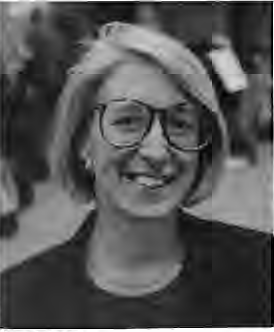
Anne Spencer, head of Crossroads School. Photographer not credited.
Originally published in The Times of Skinker-DeBaliviere, February 1993.
Read this article in the original newspaper issue.
Original source: SD_Times1993_02.pdf, printed page(s) 1; PDF page(s) 1.





