Historical March 1988 report or notice. Original dates, prices and contacts describe the source period; current availability has not been established.
If you walk into the basement of Grace and Peace Fellowship on a winter night, you’ll encounter between twenty and twenty-four women whose troubles go beyond the dead car batteries, over-cooked chickens, and ignored RSVPs common to most people.
A few of the women might be watching television, and a few others might be exercising, but many will simply be lying on cots set up in the church’s dining room. That is the bottom line at Grace and Peace Winter Shelter—a warm, peaceful place for homeless women to sleep.
But the shelter does rise above this minimum expectation, thanks in part to dozens of volunteers from the Skinker-DeBaliviere neighborhood.
The women find compassion, a little education and entertainment, and sometimes, a fresh start. Seven of the women from the 1986-1987 shelter season left to find jobs and live in their own apartments. “It’s all because they had a little bit of a stabilization period,” says LaVerna Meyer, director of the shelter and a member of Grace and Peace Fellowship.
The Grace and Peace Winter Shelter is a satellite shelter of St. Peter and Paul Winter Shelter, which is operated in St. Peter and Paul Catholic Church in Soulard.
The Soulard shelter, an ecumenical effort, accommodates homeless men.
Another satellite shelter at St. John’s Episcopal Church at 3664 Arsenal St. cares for women with children.
The Grace and Peace shelter occupies a special niche by opening its doors to women without children. Meyer says such women in the past have tended to dislike the nurserylike atmosphere of other shelters where children were accepted. “Probably 60 to 80 percent of the people we’re talking about (at the Grace and Peace shelter) are mentally ill, and they can’t tolerate noise and crowded conditions,” Meyer says.
With the St. Peter and Paul providing money, equipment, and advice, Grace and Peace established its twenty-two-bed shelter in 1986.
In the first winter season, from Dec. 1, 1986, to March 31, 1987, ninety-eight women slept there.
The average stay was twenty-four nights.
Two paid workers provide direction and continuity, but the shelter couldn’t function without the volunteers who spend the night.
In the 1986-1987 season, some eighty-five volunteers camped out in the church basement.
Other volunteers:
• Provide sack dinners (2,690 in 1985-1987).
• Lead exercise programs.
• Teach classes on hygiene, nutrition and pregnancy.
• Strum guitars during sing-alongs.
The requirements for volunteers are simple. “It takes someone who has some degree of patience and who is ready to listen,” says Meyer. •
Angela Walsh, a paid worker at the shelter, says most of the volunteers come with an attitude of “What can I do to help?” “They quickly get acclimated,” says Walsh.
The Grace and Peace Winter Shelter represents a coalition of care. Churches and organizations providing meals and volunteers include: St. Roch’s Catholic Church, Delmar Baptist Church, Grace Methodist Church, Memorial Presbyterian Church, Union Avenue Christian Church, Old Orchard Church in Webster Groves, Westminster Presbyterian Church, St. Peter and Paul Catholic Church, and the Inter-Varsity Christian Fellowship chapter at Washington University.
The shelter has expanded to twenty-four beds, but the turnover rate has dropped drastically. “This year, women have stayed from day one,” says Meyer. “We can hardly pry them out of their beds.” Homeless women cannot walk into the Grace and Peace shelter off the street.
They first must be screened by the Homeless Reception Center operated by the Salvation Army.
During the winter, the women are picked up every afternoon by Red Cross vans at Christ Church Cathedral—the daytime shelter for homeless women—and taken to the Grace and Peace shelter, which opens at 6:30 p.m.
The women must leave the shelter by 6:30 a.m. the following morning.
The Grace and Peace Winter Shelter, like others, grapples with the widespread practice years ago of taking patients out of psychiatric hospitals and similar institutions and placing them in the community. Meyer concedes that most mental patients do not require traditional, high-cost institutionalization.
But life on the street has proven just as hellish as being “warehoused” in the hospitals.
The homeless who are mentally ill “require some sort of maintenance, somebody who sees they take their medication, and who is humane,” says Meyer. “What they really need is family and support.
But that’s not what they’re getting.
The families dump them.” The next season for the Grace and Peace Winter Shelter begins Dec. 1.
To volunteer, or to obtain more information, call LaVerna Meyer at 994-7708.
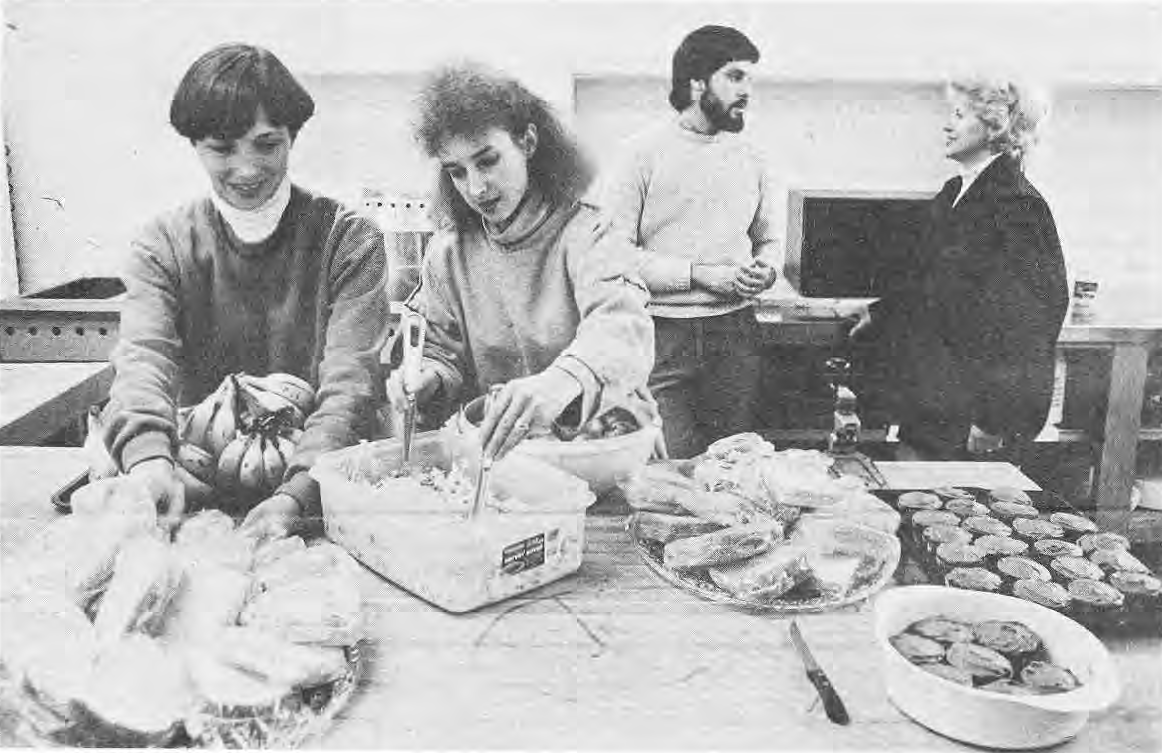
Original photograph caption
Preparing an evening meal with donated food at the Grace and Peace night shelter for women are (from left): Volunteers Katherine Lutjens and Poogy Bjerklie, while night manager Jim Bakeman and shelter director LaVerna Meyer talk and plan the evening’s activities. Photo by King Schoenfeld. The Times of Skinker-DeBaliviere, March 1988, page 1.
Originally published in The Times of Skinker-DeBaliviere, March 1988.
Read this article in the original newspaper issue.
Archival transcription note: Shelter statistics and mental-health estimates are attributed to the 1988 report/interview, not current estimates. Caption spells Poogy Bjerklie, while continuity elsewhere may differ; source retained.
Original source: SD_Times1988_03.pdf, printed page(s) 1, 8; PDF page(s) 1, 8.





